

Celanese
Santoprene® TPV 121-80B265
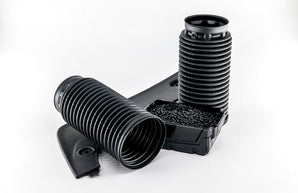
Santoprene TPV 121-80B265 is a black thermoplastic vulcanizate (TPV) that combines low coefficient of friction with good bonding to TPV and EPDM rubber. This grade offers improved heat aging performance and excellent processability for injection molding of complex geometries with excellent surface aesthetics. It has low friction retention after heat aging without surface bleeding. It has been designed for corner molding and end caps of automotive extruded weather seals in TPV or in EPDM rubber.
Key Features:
- Low friction injection molding grade
- Specially formulated to replace thermoset EPDM rubber in automotive glass run channel (GRC) corner molding applications
- Designed for shorter processing cycle time compared to thermoset EPDM rubber
- Adheres to vulcanized EPDM rubber and TPV
- Built-in low coefficient of friction properties
- Good flowability with excellent surface aspect
Processing Form:
- Injection Molding
- Multi Injection Molding
Processing Notes:
Desiccant drying for 3 hours at 80°C (180°F) is recommended. Santoprene TPV has a wide temperature processing window from 175 to 230°C (350 to 450°F). In order to obtain good bonding on an EPDM sponge profile, the injection speed should be fast (60–100 mm/sec) and at a very high temperature in a warm mold. The injection pressure should be moderate and the holding pressure kept low to prevent profile deformation. The profile should be perfectly positioned in the mold without deformation to ensure maximum surface interaction with the melt. Cooling time should be longer than a typical TPV to initiate recrystallization at the contact interface. Santoprene® TPV is incompatible with acetal and PVC.
Santoprene TPV has a relatively high melt viscosity at low shear rates. Viscosity decreases as the shear rate increases. Increasing temperature has little effect on TPV melt viscosity. Smaller gates and higher shear rates keep melt viscosity low and improve melt flow. Please also refer to the injection molding guide.
Purpose:
UV Resistant
Applications:
Automotive
Hardness:
79A
Delivery Form:
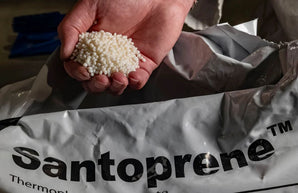
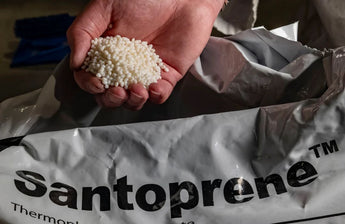
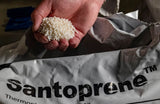
Pellets

Key Sustainability Features of Santoprene TPV
Recyclable
Unlike traditional rubber, Santoprene TPV can be reprocessed, reducing waste and improving manufacturing efficiency.
Lightweight
Reduces material usage and contributes to energy savings in transportation and logistics.
Eco-Friendly Production
Requires less energy during processing compared to traditional vulcanized rubbers.
Longevity
Durable products reduce replacement rates, minimizing overall resource consumption.